How do I cope with anxiety and stress when I feel stuck in old patterns?
Alanna Johnson - 20 March 2026

Doctoral Psychology Resident Alanna Johnson answers a student question about coping with anxiety and stress and how to move toward meaningful change. Photo credit: Adobe Stock
Dear Maddi,
I struggle with anxiety and coping with stress. It feels like I’m stuck in this cycle of feeling lost and falling back into patterns of bad coping mechanisms, and I can’t seem to get myself to do things that will actually be good for me. I’m starting medication again, which will help, but I was resistant to the idea because it meant admitting that I was in a bad place again, that I failed to put myself on the right path. How can I stick to healthy coping mechanisms outside of medication that work for me?
Dear Stuck,
Thank you for reaching out with such an important and relatable question. Feeling stuck and falling back into old coping patterns can be incredibly frustrating. It can also bring up painful thoughts like feeling that you’ve somehow “failed,” especially when restarting medication.
It’s important to say that needing medication isn’t a failure - in fact, seeking help and support when we need it is a strength. Many people use a combination of strategies like therapy, lifestyle changes and medication to manage anxiety over time.
Why Avoidance Feels So Tempting
The cycle you’re describing is very common. Our brains are wired to avoid temporary discomfort like anxiety or stress, which can make it easy to fall back on strategies that bring short-term relief, even if they don’t help in the long run. When we over-rely on short-term strategies to numb feelings of stress and anxiety, those feelings don’t go away; they tend to come back even stronger.
Let’s look at an example that many students can relate to: exam anxiety. Feeling anxious about an exam might lead you to avoid studying, maybe with some common avoidance behaviours like doomscrolling, over- or under-sleeping, over- or under-eating, drinking or using substances, isolating from friends, or procrasti-cleaning (my kitchen is never cleaner than when I have a deadline coming up!).
The more anxious I feel about the exam, the more tempting it is to pick up my phone and scroll. The relief that comes from temporarily moving away from anxiety can be so powerful that it almost feels addictive (Hoffman & Hay, 2019). However, doomscrolling only provides temporary relief. As soon as I put my phone down and remember the exam, the same rush of anxiety returns, and I might also feel guilty for “wasting time” I meant to spend studying. That guilt can intensify the anxiety, which makes the urge to avoid the feeling even stronger. Over time, these loops can leave us feeling increasingly stuck.
Seeing the Pattern
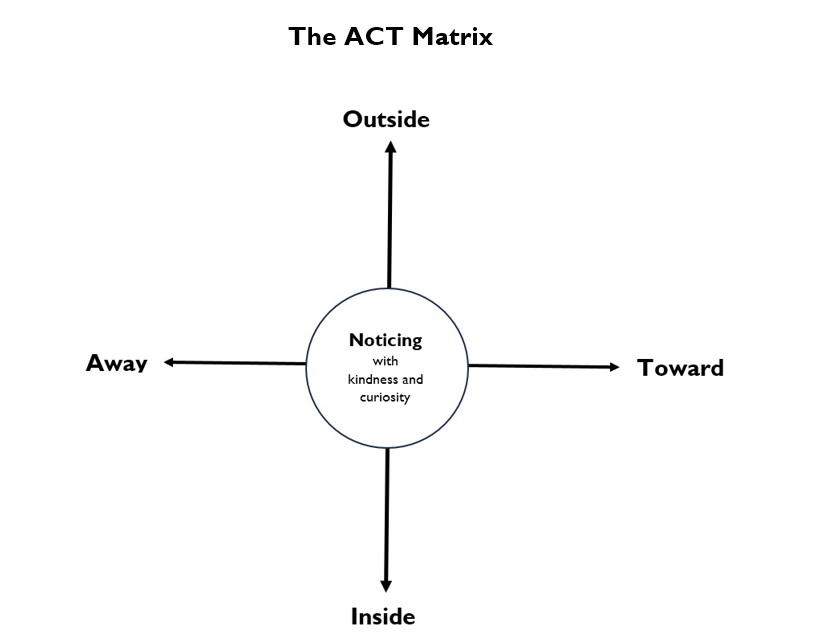
One variation of the ACT matrix.
One way people sometimes map this out is with a tool called the Matrix, from Acceptance and Commitment Therapy. It helps us notice whether our actions are moving us away from uncomfortable feelings or toward the things that matter most to us.
The top half of the ACT Matrix diagram (outside) is for outward behaviours that someone could see if they were watching you. The bottom half is for things happening inside of you: thoughts, feelings and sensations.
Some actions move us away from discomfort. For example, avoiding studying by scrolling on our phones might temporarily help us move away from anxious feelings. Other actions move us toward what matters to us, such as our values, our goals, and the people or activities that give our lives meaning.
Getting caught in avoidance loops can reinforce the message that the threat is bigger than it really is and that we’re less capable of handling it than we actually are. Over time, this can chip away at our confidence and make anxiety feel even stronger.
This doesn’t mean that “away” behaviours are always bad - it just depends on why we’re doing it. Staying up all night binge watching TV to avoid studying could be an “away” behaviour. But intentionally taking time to enjoy a show to relax or connect with a loved one could be a “toward” behaviour. The key is noticing when those behaviours start to dominate and keep us stuck in a loop.
So where do we go from here?
Awareness is an important first step. Notice how your own “stuck loop” works. Notice what feelings and thoughts show up and what behaviours lead you to move “away” from discomfort.
Many of us fall into the trap of thinking that there’s a future version of ourselves who will finally be free of anxiety: “If I could just get rid of this anxiety, then I could start doing the things I care about.”
The good news is that we don’t need to wait for that magical day. Instead, we can begin taking small steps toward the things we value, even while anxiety is present.
Moving Towards What Matters
We can feel anxious and still choose to do something we value. Allowing anxiety to come along for the ride, without letting it run the show, can loosen its grip. In other words, by accepting anxiety, we reduce its power.
Values can act like a compass. When we’re hiking, we don’t hold our compass in front of us every step of the way, but it’s helpful to pull it out when the fog rolls in, and we start to feel lost. In those moments, it can help to ask: What small action would move me toward the kind of life I want to live right now?
Sometimes that action might look like studying for the exam because you value learning and giving your best effort to the commitments you’ve made. That motivation can feel very different from studying purely to avoid the fear of failure.
Make Room for Difficult Feelings
These ideas are meant to offer starting points for bringing awareness and clarity when you feel stuck. At the same time, mental health can be influenced by many factors, and it can feel overwhelming at times. In moments like these, it can help to remember that we all experience painful thoughts and feelings at times, and life inevitably brings both joy and sorrow. Part of this approach invites us to embrace that reality. I was reminded of this recently when I saw an interview clip with one of the stars of The Pitt, who spoke about a difficult period in her life and how adopting a mindset of acceptance helped her feel more self-compassionate and free.
If it ever feels like more than you can manage on your own, remember that there are supports you can lean on for help (e.g., Counselling & Clinical Services, UASU Cares).
Wishing you all the best on the next steps of the journey,
Alanna
Written by Alanna Johnson (Ph.D. Candidate), Guest Author for Dear Maddi and doctoral psychology resident at Counselling & Clinical Services . Edited by Suman Varghese Counselling & Clinical Services Satellite Psychologist for the Faculty of Arts and GPS.
References
Hoffman, S., & Hay, A. (2019). Rethinking Avoidance: Toward a Balanced Approach to Avoidance in Treating Anxiety Disorders doi: 10.1016/j.janxdis.2018.03.004
Anxiety is Hard-wired into the Human Brain
The ACT Matrix | Association for Contextual Behavioural Science
Dear Maddi: How can I make change in my life when I feel stuck? | Dr. Budzan
Dear Maddi: Anxiety and Depression | Maddi Genovese
Meditation: A simple, fast way to reduce stress | Mayo Clinic
Videos
Rewiring the Anxious Brain: Neuroplasticity and the Anxiety Cycle: Anxiety Skills #21
10-Minute Meditation to Release Stress & Anxiety
Values vs. Goals | Russ Harris, Acceptance & Commitment Therapy
Values Clarification Exercise | Therapy in ACTion
Colbert Late Show Interview
Resources
Counselling & Clinical Services, University of Alberta